For your friends, who wonder what's up with that weird corner over there?
Showing posts with label Icons. Show all posts
Saturday, January 28, 2017
Saturday, May 10, 2014
Why are vigil lamps lit before icons?
By Bishop
Nikolai Velimirovich
1.
Because our faith is light. Christ said:
I am the light of the world (John 8:12).
The light of the vigil lamp
reminds us of that light by which Christ illumines our souls.
2. In
order to remind us of the radiant
character of the saint before whose icon we light the vigil lamp, for
saints are called sons of light (John 12:36, Luke 16:8).
3. In
order to serve as a reproach to us for
our dark deeds, for our evil thoughts and desires, and in order to call us
to the path of evangelical light; and so that we would more zealously try to
fulfill the commandments of the Saviour: "Let
your light so shine before men, that they may see your good works"
(Matt. 5:16).
4. So
that the vigil lamp would be our small
sacrifice to God, Who gave Himself completely as a sacrifice for us, and as
a small sign of our great gratitude and radiant love for Him from Whom we ask
in prayer for life, and health, and salvation and everything that only
boundless heavenly love can bestow.
5. So
that terror would strike the evil powers who sometimes assail us even at the
time of prayer and lead away our thoughts from the Creator. The evil powers love the darkness and tremble at every light,
especially at that which belongs to God and to those who please Him.
6. So
that this light would rouse us to selflessness. Just as the oil and wick burn in
the vigil lamp, submissive to our will, so let
our souls also burn with the flame of love in all our sufferings, always being
submissive to God's will.
7. In
order to teach us that just as the vigil
lamp cannot be lit without our hand, so too, our heart, our inward vigil lamp,
cannot be lit without the holy fire of God's grace, even if it were to be
filled with all the virtues. All these
virtues of ours are, after all, like combustible material, but the fire which
ignites them proceeds from God.
8. In
order to remind us that before anything
else the Creator of the world created light, and after that everything else
in order: And God said, let there be light: and there was light (Genesis
1:3). And it must be so also at the beginning of our spiritual life, so that
before anything else the light of Christ's truth would shine within us. From this light of Christ's truth
subsequently every good is created, springs up and grows in us.
Thursday, September 12, 2013
Tuesday, January 15, 2013
St. Nicholas Troparion, printable
Our dear priest brought oil from the reliquary of St. Nicholas and loaned us a small 13th century russian icon of him to keep through Christmas. It was very special to have it in our home, and surreal to think of its many years. I think its hard for Americans to really grasp history sometimes, and this icon has been confronting me with my own limited place in time, and the reality of the history that I read.
Our father among the saints Nicholas of Myra, Wonder-worker, was the archbishop of Myra in southern Asia Minor in the fourth century and is also the basis for the Santa Claus legends and imagery which accompany Christmas celebrations in much of the world.
While widely honored and venerated, not only in the Orthodox Church, but throughout most Christian groups, little is known historically of the life of Nicholas. He is known to have been archbishop of Myra and he may have participated in the Council of Nicea in 325. In addition to being honored as the patron saint of many countries, notably Greece and Russia, and of cities, he is the patron of many occupational groups, most notably of sea-farers. St. Nicholas is commemorated by the Church on December 6, and also on May 9 (the transfer of his relics) and on July 29(his nativity). - orthodoxwiki
Saturday, June 16, 2012
Rublev's Holy Trinity exists
“There exists the icon of the Trinity by St. Andrei Rublev; therefore God exists.” Fr. Pavel Florensky
" To see an icon is so very far removed from viewing an art object. First off, an icon is never an object. Faces in an icon are never in profile, but look at us face to face. To rightly see an icon is to see it in relationship, that is, to see it personally. And the person whom we see is not the wood and paint, but the one whom the image on the wood and paint represents. It is this encounter that makes it possible to speak of an iconographic proof of the existence of God. I know there is a God because I have seen His image." - Father Stephen Freeman
Tuesday, May 8, 2012
Truth of an Icon
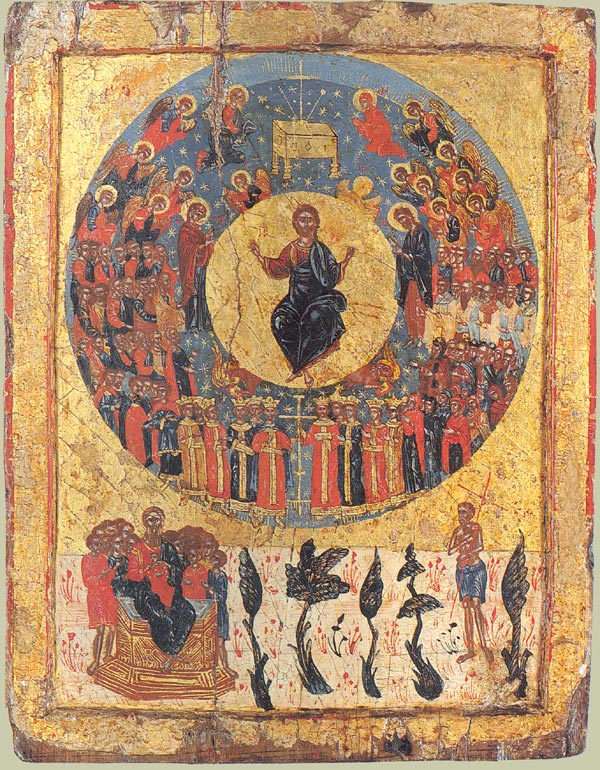
"Thus we have this rather strange aspect of icons. They are eschatological representations. They not only show us what happened (if we’re talking about a Biblical scene) but also show us what that scene means in its fullest and final sense. Saints are not painted as they might have appeared in life, but in an eschatological fashion representing how they shall be in the age to come (at least this is what the intention is behind many stylistic aspects of an icon). They are thin (not heavy and of the earth); their senses are either deemphasized (small ears, small mouth, thin and elongated hands) because they are turned inward to the heart; or overemphasized (large eyes and enlarged forehead) representing heavenly vision and wisdom. They are always presented to us face-to-face, never in profile, for the truth of who they are is only to be known personally (hypostatically) in relationsip, never as a merely existing object. This last aspect is quite notable in the resurrection appearances of Christ. He cannot be objectified." - Fr. Stephen Freeman
Saturday, February 18, 2012
Remembering
O brethren, come be fore the end, and seeing that we are earth,
and the fact that our nature is in firm,
let us be hold that we are vile and see what our end is like
and the organs of our vessel made of flesh,
and that every man is but dust, food for worms, and decay;
that our bones are dry and have no breath.
Let us look into the graves.
Where is the glory? Where is the beauty of our form?
Where is the tongue that spoke so well?
Where is the eyebrow, and where is the eye?
All is but dust and a shadow. Therefore, O Savior, spare us all.
- from matins of Saturday of Souls
Sunday, February 5, 2012
Children in the Liturgy
We
went to church for the feast of the Meeting of Our Lord even though it was the
middle of the week. The
girls did fairly well for so late at night after the long car ride, but in the middle of the liturgy
Veronica got to her usual up-too-late state: wiggles. She simply can't be
still and twists in our arms, making my arms begin to shake from the strain.
At 30 pounds, she isn't a baby anymore. She likes to turn and face
forward, so that my arms are like a chair. I assume she likes to see
what's going on, but my weary arms - oh!
At
one point, she twisted in John's arms in this way, and I saw him standing next
to me holding her forward - with the icon of the Meeting of Our Lord on the
wall beside him. I couldn't help but notice the similarity of his awkward
position with that of St. Simeon. Of course, this is also the way that the
Theotokos holds Christ in many of her icons. I think it is an iconographic
technique, sort of like cheating out onstage, so that the audience can see
everyone.
But,
in that moment, I was struck by the spiritual nature of my children. I so often
get wrapped up in trying to teach them to pray, to whisper, to just please
be quiet in church. But these children are also gifts of God, made in
his image, and pure in heart.
Parenthood
has been hard for me - there is a self emptying in being a mother that I am
continually fighting. Fr. Nikolai told us after the liturgy that our struggle
is not simply to pray in the liturgy, but to show our squirming children the
love of Christ in the liturgy - to respond to them as Christ would. Lord
have mercy! Then he added that getting through a night time liturgy
quietly is our children's struggle. It is easier to love their struggle when
you remember it is for their salvation.
Lu whispered to me when we entered the church that night, "Mommy, the icons
look different tonight!" I thought so, too.
Tuesday, December 20, 2011
The Spirituality of Color
In college, I read "Concerning the Spiritual in Art" By Wassily Kandinsky. The title appealed to my modern and spiritual sentiments, and the book did not disappoint. Kandinsky had lofty goals of creating a universal language through painting, functioning the way that music does. He believed color, specifically, carried universal and spiritual meanings - which again was very appealing to me. Although, I now feel a bit disillusioned by Kandinsky's idealism, I still adore this book for its idealism. In fact, I cannot deny how much it has shaped me. I certainly don't deny the communicative or the spiritual qualities of color (or painting), but mostly I see that language can rarely be universally understood.
Michael T.H. Sadler says in his introduction:
"If Kandinsky ever attains his ideal—for he is the first to admit that he has not yet reached his goal—if he ever succeeds in finding a common language of colour and line which shall stand alone as the language of sound and beat stands alone, without recourse to natural form or representation, he will on all hands be hailed as a great innovator, as a champion of the freedom of art. Until such time, it is the duty of those to whom his work has spoken, to bear their testimony. Otherwise he may be condemned as one who has invented a shorthand of his own, and who paints pictures which cannot be understood by those who have not the key of the cipher."
Sigh.
I do believe, perhaps naively, that much of the power of visual communication is affective on an unconscious level, meaning the viewer might never realize the impact or any particular message, however, it may still have an affect. Kandinsky says, color "is a power which directly influences the soul.” (page 25) Color functions in another way, best not described as language. Perhaps it is better experienced as the quality of air you breath, or water you drink, sometimes labored, sometimes clean, sometimes heavy, sometimes thin. Kandinsky calls this communication a "vibration."
As long as this breath, this vibration exists, then this form of painting is still valid. Perhaps I think of myself as a colour-musician more than I'd like to admit?
But, back to color.
Kandinsky first discusses the psychic affect of color, which is to some degree, commonly experienced by humans: i.e. red resembles blood and the associations that come with it: blood, death, fire, pain, passion. Nevertheless, too many variables make this type of association far from universal, as yellow might incite warm sunshine or sour lemons.
Secondly, Kandinsky discusses the movements of color, and the more spiritual meanings. Warm colors move out, while cool colors draw in; light moves out, while dark draws in. He ascribes moods to each color, paraphrased here:
yellow: agressive lunacy
blue: heavenly rest, increasing as it grows darker, decreasing as it gets lighter
blue-black: heavenly grief
green: earthly contentment
white: nothingness, pregnant silence, joy
black: dead silence, grief
gray: motionless
warm red: earthly strength, determination, triumph, sharpness, deepened by browns
cool red: deep, inward glow
light red: fleshy, femininity
orange: outward strength, confidence
violet: physical and spiritual, sadness
He went on to say much more about the movements of color and the specifics of certain pigments, so that anyone who mixes color or is familiar with cadmium or vermillian, ultramarine and pthalo, would soak it in appreciatively.
Many images of the Theotokos paint her red garment as a deep purple-red like this image of the Vladimir Theotokos of the Tender Mercy type. Here she is shown cheek to cheek with the Christ child, expressing the deep love between God and humanity. However, the sadness in her eyes is also quite evident. The grief, the "sword that shall pierce even her own soul," for all that her child will suffer is eternally present. The heavy purple contrasted with the vibrant gold embodies the "bright sadness" of the Christian faith. The joy mingled with grief.
White is used to depict holiness and divine light, but sometimes black is shown in the center of the mandorla, as the mystery of the divine light. Grey and pink are ambiguous, fleshly colors incapable of the transcendence of iconography, and are thus not included.
This use of color in iconography was well established over 1000 years before Kandinsky wrote about his color theory. Certainly the iconography uses it in a more literally symbolic way, while Kandinsky uses it more fluidly. One might suggest that he, as a Russian, was influenced by Russian iconography. But one might also argue that these colors somehow inherently possess these meanings and movements, that they are ever present and affecting us.
Subscribe to:
Posts (Atom)


