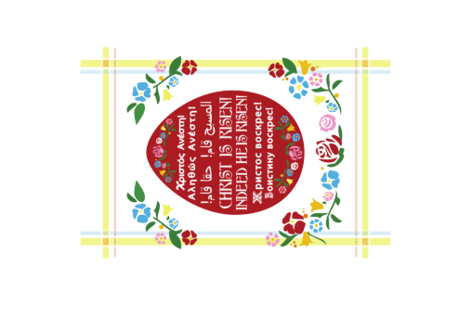
You guys, I love Easter.
Easter, or Pascha, along with Lent and Holy Week, has become my favorite time of year. These days of intense preparation are beautiful and difficult and call me back to a place of deep joy.
So each year around this time, when I see people lamenting bunnies and pastel eggs, and dismissing the whole thing as pagan, I want to remind them of the beautiful Christian origins of this feast. This is the Feast of feasts! Early Christians didn't keep this feast because they secretly didn't want to give up their pagan traditions - they had the greatest reason of all to celebrate. We, too, have every reason to celebrate this day with joy - even with eggs and baskets!
So, to encourage you to embrace this season, I've put together a brief list of Easter facts and symbols explaining their origins (with sources). I'm not a historian, so I'm relying heavily on wikipedia, and in this case, I'm grateful for the communal knowledge it offers on the subject. I'm also including some pictures from my family's celebration of Pascha in recent years. Here we go!
1. "Easter" or "Pascha"
 |
Icon of Christ on the cross at St. Nicholas
Orthodox Church in Jackson, TN, 2015 |
The word "Easter" derives from the old Germanic word for the month Easter usually fell in: Ēosturmōnaþ (our month of April). The month was named for the goddess Eostre, a germanic divinity, in the same way that many of our months are named for Roman gods. This connection to the goddess is dependent solely on a statement by Bede in the 8th century. But the celebration of Easter undoubtedly preceded the term.
(Wikipedia: Easter Etymology)
Early Christians actually called the feast by the greek name for Passover, since the resurrection happened during the Passover weekend and the earliest Christians were Jews.
Πάσχα or Pascha is the greek word. (
Wikipedia: Easter Etymology) The words can be used interchangeably. In the US, the name "Pascha" is still used by Orthodox churches.
In
1 Corinthians, Paul calls Christ the passover, or Pascha, "For even Christ our passover is sacrificed for us: Therefore let us keep the feast, not with old leaven, neither with the leaven of malice and wickedness; but with the unleavened bread of sincerity and truth." Christ fulfills the old feast, and is himself the new feast!
2. Beginnings
Easter began as Jewish Christians continued to celebrate Passover with the new Christian implications.
A fully formed Christian celebration of Pascha is evidenced by the mid-2nd century by the Paschal homily of Melitos of Sardis.
(Wikipedia: Easter in the Early Church, and the Homily)
3. Lent
The term "lent" is derived from an old English term meaning spring.
In Greek speaking countries it is called Μεγάλη Τεσσαρακοστή, which means "Great 40 days," but still called "Great Lent" in English.
(Wikipedia: Great Lent)
In the early church, new Christians prepared for their baptism with a period of fasting and prayer. This gradually developed into a 40 day fasting period, and was connected to Easter, and was eventually adopted by the whole community in communion with the new Christians' baptism. The liturgical celebration of Lent and Holy Week vary in the East and West, especially in duration/structure, and among Orthodox Christians customs vary in different regions, but they all originated as a time of repentance and preparation for baptism. For Catholics, Ash Wednesday is 45 days before Easter, or 40 days if you don't count the Sundays. For Orthodox, Lent starts on Clean Monday, 48 days before Pascha, or 40 days plus Holy Week.
(Wikipedia: Lent)
Holy Week is an intense week of services, walking us through the final days of Christ's life. My favorite part begins when we read 12 gospel passages about the passion on Thursday night and during the service nail an icon of Christ on a cross. On Friday morning, the children decorate the funeral bier with flowers. Then, we have a shorter service remembering Christ being taken down from the cross, during which the icon is taken down and wrapped in a sheet and laid on the funeral bier. That night we carry the funeral bier in a procession around the church, and re-enter the church by going under the bier (symbolizing our union with Christ in death). Holy Friday services are powerful and beautiful!
On Saturday night, around midnight, the church is dark. Slowly, chanting a beautiful invitation to receive Christ's light, the priest brings one candle from the altar, and everyone lights their candle until the church is full of light. Soon, we shout and sing Christ is risen in many languages. The fast is over and the celebration has begun. After the Liturgy, we have a big feast in the middle of the night, eating all the foods we've been fasting from. I love that all of our serious hard work ends with full-hearted fun.
4. The date
Churches in the East and the West
use the same ancient formula to calculate the date of Easter, but the East uses the old Julian Calendar as opposed to the new Gregorian calendar. So Eastern churches celebrate Pascha sometimes several weeks after Western Eastern, although occasionally they still fall on the same date. You can read the specifics of the calculations at the link.
(Wikipedia: Easter computations) In 2016, Easter and Pascha are 5 weeks apart! So if you miss out on Western Easter, you still have time to join in on Eastern Pascha. ;) In 2017, we'll celebrate together!
5. Easter Baskets
 |
Easter baskets at the front of the church at
St. Nicholas Orthodox Church |
Early Christians fasted prior to Easter by giving up meat, eggs, and dairy (as well as wine and oil). So when Pascha arrived,
they brought baskets of these rich foods to the church to be blessed. After the Paschal Liturgy they feasted on these foods in the spirit of the joy of the resurrection.
(Wikipedia: Easter Egg Lenten Tradition)
Eastern Orthodox Christians still keep this tradition, with varying customs. In our church, we bring our baskets, laden with food and decorated with flowers and fancy cloth covers (
like mine shown at the top), into the front of the nave of the church during the Liturgy. At the very end of the service, the priest blesses the eggs and "flesh meats" - and then we take the baskets to the hall to enjoy our feast together. Besides food for the church feast, many families include foods that they will take home and enjoy throughout the rest of Bright week as they continue to celebrate at home. In our basket, we included butter, eggs, chocolate for the kids, summer sausages and fancy cheeses.
 |
| Our Pascha Basket, 2016 |
6. Easter Eggs
Eggs are certainly a sign of new life and spring, and this fits thoroughly with the themes of Passover and Easter. While pastel and chocolate eggs are modern traditions, the egg itself has long been associated with Christian Easter.
The egg reminds us of a stone, but, like Christ's tomb, it breaks open to reveal new life. (Wikipedia: Easter Egg)
Orthodox Christians traditionally dye their eggs not in pastels, but deep red for the blood of Christ, which yields this new life. The tradition of red eggs comes from legends about Mary Magdalene, my patron saint.
(Wikipedia: Easter Eggs Legends) The one I'm most familiar with tells how Mary shared the gospel with the Roman Emperor. When appearing before the emperor, one usually brought a gift, and Mary, having given away all of her possessions to the poor, brought a humble egg. The emperor was offended by her simple gift, and when she told him that Christ was risen from the dead, he rudely replied, "He is no more risen than that egg is red!" And immediately the egg turned red in her hand. (
From a Children's Paradise of Saints)
I can appreciate another reason eggs may have become abundant at Easter celebrations. Christians fasted from eggs during the springtime, when hens suddenly begin laying lots of eggs! So by the time Easter arrived, they needed to eat all the eggs so they wouldn't go to waste. We have a dozen or so chickens at our house, so I try to dye a bunch of red eggs to share each year!
 |
| my red eggs, ready to go to church! |
7. The Easter Bunny
 |
A beeswax egg candle, cadbury eggs, homemade donuts for breakfast;
bunny (!) legos and new bibles were in the kids' Pascha baskets last year. |
Orthodox Christians don't have any bunnies in their traditions, although I might still eat a chocolate one! Wikipedia suggests the easter bunny was developed later by German Lutherans to reward good children much like Santa Claus. So, although this is one of the customs people are quick to call pagan, it seems to be just a fun, folk tradition with springtime symbols.
(Wikipedia: Easter Bunny Association with Eostre) We don't play Easter bunny in our family, but we still enjoy treating the kids with baskets of their own on the following morning, with chocolates, books, and toys. Here's our Pascha breakfast table, late on Pascha Sunday last year (after we came home and slept off our late night Liturgy and feast).
So there you go. Whatever customs you don't like, the thoroughly Christian traditions are rich enough that you can easily do without bunnies and pastels and still celebrate this feast with joy.
This video shows the end of the procession at the Paschal vigil last year. We've just filled the dark church with light and we begin to shout, "Christ is risen!" in many languages. Last year, I had a 1 week old newborn, but I didn't want to completely miss our mission church's first Paschal celebration, so baby and I sat in the narthex to watch, and that's where I took this video. Towards the end, you can see our baskets at the front of the church and children sleeping in the chairs - this is the joy at the end of the journey.
End of the procession during Paschal Matins. Christ is risen!
I've mostly discussed the light-hearted customs of baskets and eggs, but they are only a small part of this rich feast. The celebration of Pascha reveals the mystery of the Christian faith in the resurrection, the eighth day. More than just remembering the resurrection, we immerse ourselves in it "to experience the new creation of the world, a taste of the new and unending day of the Kingdom of God."
(Orthodoxwiki: Great and Holy Pascha) So don't miss out on this Feast of feasts on account of bunnies or pagans. Instead, let's celebrate it with prayer, struggle and beauty, with fun and food, singing and shouting "Christ is risen!" because, truly, He is risen.
-----------------
More Reading: